Showing posts with label Robert Frost. Show all posts

Monday, February 24, 2014

Stopping by Schneedreck on a Sunny Afternoon

As a recent article about skiing and climate change attests, poets have always been fascinated by snow. Eskimos, it is often said, have many words for the stuff. But what would the poets call the thick, hard substance spackling the cobblestones of Brooklyn’s Old Fulton Street last weekend? Maybe the Eskimo would look and say, “Pukak!” If so, would they be right? The mysterious Old Fulton gunk was contiguous in places with patches of identifiable snow and ice—but overall it was black, and also impervious to light and warmth. Saturday was the first warm day in many brutal weeks of winter, but the substance wasn’t even wet and if anything was growing. In color and luster, it bore some resemblance to beef tongue. On closer inspection, however, it was more like a terrine of dirt, salt, snow, and refuse.

166 years ago, Walt Whitman wrote for the Brooklyn Daily Eagle in a building right there on Old Fulton, but poems like “To a Locomotive in Winter,” don’t mention the snow-filth of February. Perhaps it was unknown to Whitman and his time, but I doubt it. Maybe it's unknown to scientists, however, this unmeltable garbage-ice that fears no salt or sun. It certainly isn’t the first February in which I’ve encountered it. I remember it well from my snowy growing-up in Cleveland. (Offended Clevelanders: please address all letters of complaint to Anne Trubek, c/o the Cleveland Plain Dealer.)

In any case, the words “snow-filth,” “garbage-ice,” or “snow-grime” would not do justice to the frozen black head-cheese on Old Fulton Street, because the hyphen divides that which has in fact fused and metamorphosed into something wholly new, something unlike snow, filth, ice, garbage, or grime. The word for it therefore ought to be strange—a foreign import. Since German often fuses root words to make new meanings, I put “snow” and “grime” into my Talking Translator and out came Schnee and Schmutz. But only a long blast of nitrous oxide at the dentist’s office can prepare somebody to pronounce Schneeschmutz. The good news is that Dreck means much the same thing as Schmutz. In addition, Dreck carries with it a note of invective (at least in the idiom of Americanized Yiddish). Thus I discovered the word Schneedreck—which was almost like discovering what exactly Schneedreck is, but not quite. A cursory internet search on Schneedreck turns up over 2 million hits, but an image search on the word only yields a lot of pictures of robots and artificial knees. Who can fathom this Schneedreck?

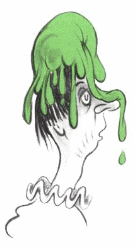
I believe Schneedreck to be a near relative of the Oobleck that fell on the Kingdom of Didd in The-Year-the-King-Got-Angry-with-the-Sky. That happens in one of Dr. Suess’s few prose works, a fine story called Bartholomew and the Oobleck, first introduced to me by my Uncle Zack.

Whatever Schneedreck is, it looks like I feel. It’s been a long winter, one that saw polar winds loosed on the Northern Hemisphere by melting Arctic sea ice, and that filled my chest and nose with Oobleck for seven straight weeks, attaining a peak rate of two tissue-boxes a day. As Wallace Stevens wrote in his lovely winter poem “The Snowman”:


One must have a mind of winter
To regard the frost and the boughs
Of the pine-trees crusted with snow;


And have been cold a long time
To behold the junipers shagged with ice,
The spruces rough in the distant glitter


Of the January sun; and not to think
Of any misery in the sound of the wind….


To have a “mind of winter”—what does it mean? I have not so much a mind as a maxillary sinus of it. Who can prepare one’s mind, or sinuses, for so much winter?

It’s one of those weird authorial coincidences that the master bard of winter should be named Robert Frost. Snow probably falls more heavily in the poems of Frost than in those of any other writer. Some beautiful ones are “Stars,” “Storm Fear,” “Stopping by Woods on a Snowy Evening,” “A Patch of Old Snow” (his only Schneedreck poem, so far as I know), “Birches,” “The Wood-Pile,” “Dust of Snow”—and then there is “Snow.” It’s one of his dialogue poems, a little play like “The Death of the Hired Man.” In it Meserve, the storm-warrior, pays a visit to Mr. and Mrs. Coles before going back out in the snowstorm. He tells them:


“You make a little foursquare block of air,
Quiet and light and warm, in spite of all
The illimitable dark and cold and storm,
And by so doing, give these three, lamp, dog,
And book-leaf, that keep near you, their repose;
Though for all anyone can tell, repose
May be the thing you haven’t, yet you give it.
So false it is that what we haven’t we can’t give….”
ll. 141-149
And then:


“Our snowstorms as a rule
Aren’t looked on as man-killers, and although
I’d rather be the beast that sleeps the sleep
Under it all, his door sealed up and lost,
Than the man fighting it to keep above it,
Yet think of the small birds at roost and not
In nests. Shall I be counted less than they are?”
ll. 222-227


Meserve then walks back out into the storm at night, against the pleading of Mrs. Coles. Meserve’s a sort of king who’s angry at the sky, who offers himself and us repose by saying what we feel. Mrs. Coles doesn’t understand his war. Having learned he made it home to his wife and child a few hours later, enduring the snow like a rugged piece of beeftongue Schneedreck, she’s mightily irritated. “What did he come in for?” she cries scornfully. “Thought he’d just call to tell us it was snowing.” She abuses him as though he were an actual poet.
Saturday, February 9, 2013

Tree Hugging

The Life of the Skies: Birding at the End of NatureThe Life of the Skies: Birding at the End of Nature by Jonathan Rosen

Rabbinic tales about the famously wise King Solomon tell of his special ability to talk to animals and to apprehend the subtleties of nature. As such, the Solomon legends hold particular interest for Jonathan Rosen, who himself writes of birds and nature--and of those who write about birds and nature--with a rather Solomonic subtlety.

"Darwin did more than anyone since the serpent in Genesis to disturb the feeling that we were safe in a world of sacred guarantees," Rosen writes (p. 176). But Rosen is less interested in Darwin's ramifications for theology and more interested in how naturalists and poets after Darwin have rediscovered a kind of spirituality, if not religion, in nature itself. He reports on a shift of weltanschauung that Thoreau biographer Robert Richardson called "the shift from the old religion of God to the new religion of nature." (p. 247) The Big Bang inspires a certain religiosity, for example, that Rosen articulates perfectly: "With science like that, who needs mysticism?" (p. 173) According to Rosen, Emily Dickinson's poem that begins "A Bird came down the Walk" belongs to this shift too: "birdsong has taken the place of church music in this poem." (p. 193)

For American poets, who are naturalists maybe by way of America's wide open spaces, birds seem to play a special role as emissaries of the mystic majesty of nature. They sing a harmonic line throughout the poems of Whitman, Dickinson, Frost, and Stevens and Rosen is a consummate analyst of such birdsong. Their power of flight and song, and their gratuitous beauty of coloration, must partly explain their fascination for poets. But in an urban environment, Rosen suggests, the birds are also the last representatives of the wild. (They are at least the loveliest if not the last--with all due respect to rats and roaches.) They're "the only animals that make house calls." (p. 193)

The dark side of the new post-pagan, post-Christian nature religion is that it can still partake of the ascetic fervor of religions of old. Henry David Thoreau is a good example. Rosen writes that "Thoreau attempted to marry nature the way nuns marry God." (p. 149) One could even say that the passion for virgin forest is sometimes a plea for literal virginity itself. "I think that I shall never see / A poem lovely as a tree," Joyce Kilmer wrote just before volunteering himself as cannon fodder in the first World War. "Poems are made by fools like me, / But only God can make a tree," the poem concludes. Maybe so. But that sapling poem has outlived a good number of forests.

The neglect of nature is unaesthetic, uncultured, and unfeeling to the living things that share our home planet, whether man, mouse, or mycorrhiza. But an excess of chastity about the human footprint in nature is, as Rosen rightly argues, a form of martyring despair and a flight from love.

Rosen states succinctly: "The great question facing us today is, Can we be both [environmentalist and humanist]?" (p. 248) "Extremism--of religion or materialism--of pure environmentalism or pure urbanism--is not the way." (p. 251)

Tuesday, November 13, 2012

The Second-Highest Heaven (Big Bang Part II)

descriptionDarrel Abel was born in Lost Nation, Iowa in 1911. He taught American literature at Purdue for many years, and at some point, working from the obscurity of Lisbon Falls, Maine, he produced a rather lovely little paper called "Robert Frost's 'Second-Highest Heaven'," which he published in 1980. The paper's title refers to a piece of Frost's prose on Ralph Waldo Emerson. Frost wrote:
Everybody votes in heaven but everybody votes the same way, as in Russia today. It is only in the second-highest heaven that things get parliamentary.
Abel goes on to quote one of Frost's letters, which expresses a similar sentiment:
whatever great thinkers may say against the earth, I notice that no one is anxious to leave it for either Heaven or Hell. Heaven may be better than Hell as reported, but it is not as good as earth.
Frost was an American who knew the pioneer's feeling of diminution before the vast inhuman wilderness, "An emptiness flayed to the very stone," as he describes an abandoned, clear-cut piece of land in his brilliant 1923 poem "The Census-Taker." Like his predecessors Emerson, Thoreau, Whitman, and Melville, he saw in the American situation a figure of the human situation in the universe itself. And like those former masters of American modernity, Frost refused despair any lasting purchase. They refused despair not because they were plucky and upbeat, but because they saw too deeply to ignore the true proportions between chaos and beauty, emptiness and humanness, in this complex, mysterious world of ours.

As Abel points out, Frost's famous poem "Desert Places" consciously rebuts Blaise Pascal in his terror at the emptiness between the stars. Here is Pascal worrying about space in his Pensées. You've heard of "penis envy" and "castration anxiety"--call this pensée anxiety:
When I consider the short duration of my life, an eternity that stretches behind and before, and the little space which I fill and even see, engulfed in the immensity of spaces I know not and which know not me, I am frightened and astonished at being here rather than there; for there is no reason why here rather than there, why now rather than then.... The eternal silence of the infinite spaces--it frightens me. Quoted in "Robert Frost's 'Second-Highest Heaven'" by Darrel Abel, Colby Library Quarterly, Vol. 16: Iss. 2, Article 3, 1980


The Big Bang can amplify the terror Pascal describes, which is in the first place not so easily dismissed. Paul Tillich, according to Abel, called such cosmic queasiness modern man's "real vertigo in relation to infinite space." Big Bang astronomy of course implies that those spaces, those desert places are not just infinite but stretching out, and so they're diminishing our physical stature in the cosmos. (To diminished stature, I say, so what? Short people achieve amazing things nowadays. Who cares how big or small we are in relation to the cosmos? Why should an electron care if it's smaller than the atomic nucleus? And would my funny bone feel any better if my elbows were the size of the Horsehead Nebula?) The vertigo is the more horrible thing; the Big Bang theory creates it by explaining so much without successfully delivering us from the painful tautologies with which we began our search for knowledge. It's the intellectual equivalent of whirling around and around.

Infinity and eternity aren't problematic because they're big (and they're not always big--a finite space may be infinitely subdivided), but because they're at once inescapable and nonsensical aspects of the cosmos. Mathematics seems to acknowledge as much since the symbol for infinity, ∞, also means "undefined." (As in 20 divided by zero = ∞.) The universe appears to have begun at a point in time. But how does something come from nothing? What was before? Something else? Some other universe? None of the alternatives appeal to common sense, and so the Big Bang theory pictures a universe whose perfectly comprehensible laws lead to perfectly incomprehensible conundra of origins and endings, limits and infinity. That's how I interpret Tillich's vertigo, and the theme of Frost's poetry--in Abel's words, "man's lostness in space." Not only do we not understand the limits of the universe in time and space, but it seems they are constitutionally inaccessible to understanding. They are non-parameters, they are outside reason and experience, yet reason and experience lead us straight to their door.... This is a miserable and untenable state of affairs.

In the last decades, the mental health field has often and without good reason blurred the traditional medical dividing line between symptom and diagnosis. I would argue that pensée anxiety, Tillich's vertigo, Big Bang-o-phobia, etc., is not a diagnosis. It's not even its own symptom. Rather, it's but one instance of a more commonplace problem I call "under-the-hood nausea." (For a fuller discussion of under-the-hood nausea, here is another blog I wrote on the subject. Under-the-hood nausea, in turn, is but a manifestation of neurosis.)

Science reaches out, by instruments and inferences, into planes of reality that exist on different scales from our own. This is what creates under-the-hood nausea. The Big Bang was named by Fred Hoyle, an important physicist who happened to despise the theory and applied the phrase "Big Bang" in derision. But the theory is perhaps rightly named in the sense that it bashes you over the head with under-the-hood nausea like nothing else. It's looking under the hood of the cosmos, and just as looking inside the body at the guts makes some people feel sick, looking under the hood of the cosmos can fill you with vertiginous questions: What is infinity? Why is there something rather than nothing? Is there a god? If there is, can I still masturbate? Why are so many cosmologists named George?

Scientists must look at reality on every plane, at every magnification, but if we can't relate our findings to our own scale, our own plane, then the work of comprehension isn't done. If we can't interpret and appreciate our knowledge in human terms, then the science may have the effect of urging us on in our despair--despair which belongs to our own homely little world of birth and death and not to the vacuous spaces between the stars. Help me, Mr. Frost:
They cannot scare me with their empty spaces
Between stars--on stars where no human race is.
I have it in me so much nearer home
To scare myself with my own desert places.


Wittgenstein was a very fine doctor for treating sickening cosmic questions. He suggested that such questions must have bad syntax--just like the meaningless proposition twenty divided by zero. If you look out into the cosmos and feel despair, remind yourself that despair is 100% human. If our understanding of physics is too incomplete right now to relate the cosmic to the quantum to the human scale of affairs, our psyches do it for us in a crude way--with despair. Yet the more we look, the more order we see in the universe. In that sense, the universe appears to be a more and more hospitable place the more we learn about it--a more human place, since humanity and life are founded on a principle of order and the development of more of it.

Fred Hoyle, the Big Bang skeptic, discovered how heavy elements are forged in the furnaces of the stars and he did it by an anthropic inference: we exist; we're made of carbon; therefore nucleosynthesis of carbon must occur; therefore stars must have a way of doing it; therefore certain isotopes of helium and beryllium must react quickly to form an excited conformation of carbon-12. He was right. Multiple generations of stars must refine lighter elements in their breasts to make heavier ones like carbon. The stars are our mothers and fathers. The universe has music in it. It has despair in it. But it's all ours.

Like the joke says:
There was a costume party where everybody was instructed to dress as an emotion. The party hosts greeted the first guest, who was dressed from head to toe in red, and asked him, "What emotion are you supposed to be?" He said, "Rage." The next guest was dressed all in green--green tights, green leotard, a green hat. When they asked what emotion she was supposed to be, she said, "I'm envy." Then a guy came to the door completely naked, with a pear stuck on the end of his penis. The hosts asked, "What emotion are you?" He said, "I'm fuckin' despair."

Friday, February 24, 2012

Snowflakes: Pictures of God?

The Art of the Snowflake: A Photographic AlbumThe Art of the Snowflake: A Photographic Album by Kenneth Libbrecht

Professor Libbrecht has braved many a winter day in the frozen countrysides of Wisconsin and Alaska and elsewhere, harvesting snowflakes on glass slides and photographing them under the microscope in what he describes as an unusual hobby. He also studies crystal formation professionally and explains quite clearly how snowflakes form, how the geometry of H2O predestines their hexagonal structure, what rime and graupel are (sounds like two sisters in a Grimm's fairy tale or ingredients in a cardboard-tasting high-fiber cereal, but no), how the stochastic intercourse of humidity and temperature and wind create a unique life-history for each falling snowflake, which records that history in its physical form--rounding off when falling through a warm patch of air, for example, then continuing to accumulate more or less ice on its prominent corners in a cold zone to acquire a stellar shape.

Libbrecht quotes from William Matthews (who is he?): "And here comes the snow, a language in which no word is ever repeated." Sometimes the simplest things, those facts acquired in the wide-eyed days of elementary school, are still the most stirring to the soul: every snowflake different from all those that ever have been or ever will be! Jorge Luis Borges had nightmares about a machine that could generate all combinations and permutations of letters in an alphabet, thereby creating every work of literature that ever has been and ever will be. But if you do the math, the number of combinations and permutations of even one page of letters of the Roman alphabet is of an order of magnitude larger than those that describe the size and age of the visible universe! Infinitude can be terrifying in its incomprehensibility when one feels down, and finitude can be equally terrifying and incomprehensible, and yet doesn't the snowflake reflect something wonderful and human? That the ephemeral form is not without significance, being the one and only record of existence at particular coordinates in time and space, a beauty rendered from the heavens with careless ostentation, beauty that can be seen like airborne diamond dust, tasted on the tongue like a mint leaf, or sledded on.

Read this book alongside the poems of winter bard Robert Frost and go skiing or snowshoeing through woods "lovely dark and deep" and remember that a poem like ice must "ride on its own melting." Sometimes it must be enough to look at the universe and say, 'Though my understanding is incomplete I know this: that it is good.' Or at least, 'Just because I don't understand it all, I know not why it should be bad.'

Personal quirk: I find snowflakes of the double-plated variety and snowflakes that are "capped columns" disgusting and always did, even when I was a kid and examined them on the sleeve of my winter coat. Yet the clouds apparently keep making them. (They do look better under a microscope, however.)

View all my reviews