
As a recent
article about skiing and climate change attests, poets have always been fascinated by snow. Eskimos, it is often said, have
many words for the stuff. But what would the poets call the thick, hard substance spackling the cobblestones of Brooklyn’s Old Fulton Street last weekend? Maybe the Eskimo would look and say, “Pukak!” If so, would they be right? The mysterious Old Fulton gunk was contiguous in places with patches of identifiable snow and ice—but overall it was black, and also impervious to light and warmth. Saturday was the first warm day in many brutal weeks of winter, but the substance wasn’t even wet and if anything was growing. In color and luster, it bore some resemblance to beef tongue. On closer inspection, however, it was more like a terrine of dirt, salt, snow, and refuse.
166 years ago, Walt Whitman wrote for the Brooklyn Daily Eagle in a building right there on Old Fulton, but poems like “To a Locomotive in Winter,” don’t mention the snow-filth of February. Perhaps it was unknown to Whitman and his time, but I doubt it. Maybe it's unknown to scientists, however, this unmeltable garbage-ice that fears no salt or sun. It certainly isn’t the first February in which I’ve encountered it. I remember it well from my snowy growing-up in Cleveland. (Offended Clevelanders: please address all letters of complaint to Anne Trubek, c/o the
Cleveland Plain Dealer.)
In any case, the words “snow-filth,” “garbage-ice,” or “snow-grime” would not do justice to the frozen black head-cheese on Old Fulton Street, because the hyphen divides that which has in fact fused and metamorphosed into something wholly new, something unlike snow, filth, ice, garbage, or grime. The word for it therefore ought to be strange—a foreign import. Since German often fuses root words to make new meanings, I put “snow” and “grime” into my Talking Translator and out came Schnee and Schmutz. But only a long blast of nitrous oxide at the dentist’s office can prepare somebody to pronounce Schneeschmutz. The good news is that Dreck means much the same thing as Schmutz. In addition, Dreck carries with it a note of invective (at least in the idiom of Americanized Yiddish). Thus I discovered the word
Schneedreck—which was almost like discovering what exactly
Schneedreck is, but not quite. A cursory internet search on
Schneedreck turns up over 2 million hits, but an image search on the word only yields a lot of pictures of robots and artificial knees. Who can fathom this
Schneedreck?
I believe
Schneedreck to be a near relative of the Oobleck that fell on the Kingdom of Didd in The-Year-the-King-Got-Angry-with-the-Sky. That happens in one of Dr. Suess’s few prose works, a fine story called
Bartholomew and the Oobleck, first introduced to me by my Uncle Zack.
Whatever
Schneedreck is, it looks like I feel. It’s been a long winter, one that saw
polar winds loosed on the Northern Hemisphere by melting Arctic sea ice, and that filled my chest and nose with Oobleck for seven straight weeks, attaining a peak rate of two tissue-boxes a day. As Wallace Stevens wrote in his lovely winter poem “The Snowman”:
One must have a mind of winter
To regard the frost and the boughs
Of the pine-trees crusted with snow;
And have been cold a long time
To behold the junipers shagged with ice,
The spruces rough in the distant glitter
Of the January sun; and not to think
Of any misery in the sound of the wind….
To have a “mind of winter”—what does it mean? I have not so much a mind as a maxillary sinus of it. Who can prepare one’s mind, or sinuses, for so much winter?
It’s one of those weird authorial coincidences that the master bard of winter should be named Robert Frost. Snow probably falls more heavily in the poems of Frost than in those of any other writer. Some beautiful ones are “Stars,” “Storm Fear,” “Stopping by Woods on a Snowy Evening,” “A Patch of Old Snow” (his only
Schneedreck poem, so far as I know), “Birches,” “The Wood-Pile,” “Dust of Snow”—and then there is “Snow.” It’s one of his dialogue poems, a little play like “The Death of the Hired Man.” In it Meserve, the storm-warrior, pays a visit to Mr. and Mrs. Coles before going back out in the snowstorm. He tells them:
“You make a little foursquare block of air,
Quiet and light and warm, in spite of all
The illimitable dark and cold and storm,
And by so doing, give these three, lamp, dog,
And book-leaf, that keep near you, their repose;
Though for all anyone can tell, repose
May be the thing you haven’t, yet you give it.
So false it is that what we haven’t we can’t give….”
ll. 141-149
And then:
“Our snowstorms as a rule
Aren’t looked on as man-killers, and although
I’d rather be the beast that sleeps the sleep
Under it all, his door sealed up and lost,
Than the man fighting it to keep above it,
Yet think of the small birds at roost and not
In nests. Shall I be counted less than they are?”
ll. 222-227
Meserve then walks back out into the storm at night, against the pleading of Mrs. Coles. Meserve’s a sort of king who’s angry at the sky, who offers himself and us repose by saying what we feel. Mrs. Coles doesn’t understand his war. Having learned he made it home to his wife and child a few hours later, enduring the snow like a rugged piece of beeftongue
Schneedreck, she’s mightily irritated. “What did he come in for?” she cries scornfully. “Thought he’d just call to tell us it was snowing.” She abuses him as though he were an actual poet.
 As a recent article about skiing and climate change attests, poets have always been fascinated by snow. Eskimos, it is often said, have many words for the stuff. But what would the poets call the thick, hard substance spackling the cobblestones of Brooklyn’s Old Fulton Street last weekend? Maybe the Eskimo would look and say, “Pukak!” If so, would they be right? The mysterious Old Fulton gunk was contiguous in places with patches of identifiable snow and ice—but overall it was black, and also impervious to light and warmth. Saturday was the first warm day in many brutal weeks of winter, but the substance wasn’t even wet and if anything was growing. In color and luster, it bore some resemblance to beef tongue. On closer inspection, however, it was more like a terrine of dirt, salt, snow, and refuse.
166 years ago, Walt Whitman wrote for the Brooklyn Daily Eagle in a building right there on Old Fulton, but poems like “To a Locomotive in Winter,” don’t mention the snow-filth of February. Perhaps it was unknown to Whitman and his time, but I doubt it. Maybe it's unknown to scientists, however, this unmeltable garbage-ice that fears no salt or sun. It certainly isn’t the first February in which I’ve encountered it. I remember it well from my snowy growing-up in Cleveland. (Offended Clevelanders: please address all letters of complaint to Anne Trubek, c/o the Cleveland Plain Dealer.)
In any case, the words “snow-filth,” “garbage-ice,” or “snow-grime” would not do justice to the frozen black head-cheese on Old Fulton Street, because the hyphen divides that which has in fact fused and metamorphosed into something wholly new, something unlike snow, filth, ice, garbage, or grime. The word for it therefore ought to be strange—a foreign import. Since German often fuses root words to make new meanings, I put “snow” and “grime” into my Talking Translator and out came Schnee and Schmutz. But only a long blast of nitrous oxide at the dentist’s office can prepare somebody to pronounce Schneeschmutz. The good news is that Dreck means much the same thing as Schmutz. In addition, Dreck carries with it a note of invective (at least in the idiom of Americanized Yiddish). Thus I discovered the word Schneedreck—which was almost like discovering what exactly Schneedreck is, but not quite. A cursory internet search on Schneedreck turns up over 2 million hits, but an image search on the word only yields a lot of pictures of robots and artificial knees. Who can fathom this Schneedreck?
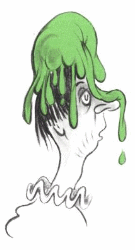
I believe Schneedreck to be a near relative of the Oobleck that fell on the Kingdom of Didd in The-Year-the-King-Got-Angry-with-the-Sky. That happens in one of Dr. Suess’s few prose works, a fine story called Bartholomew and the Oobleck, first introduced to me by my Uncle Zack.
Whatever Schneedreck is, it looks like I feel. It’s been a long winter, one that saw polar winds loosed on the Northern Hemisphere by melting Arctic sea ice, and that filled my chest and nose with Oobleck for seven straight weeks, attaining a peak rate of two tissue-boxes a day. As Wallace Stevens wrote in his lovely winter poem “The Snowman”:
As a recent article about skiing and climate change attests, poets have always been fascinated by snow. Eskimos, it is often said, have many words for the stuff. But what would the poets call the thick, hard substance spackling the cobblestones of Brooklyn’s Old Fulton Street last weekend? Maybe the Eskimo would look and say, “Pukak!” If so, would they be right? The mysterious Old Fulton gunk was contiguous in places with patches of identifiable snow and ice—but overall it was black, and also impervious to light and warmth. Saturday was the first warm day in many brutal weeks of winter, but the substance wasn’t even wet and if anything was growing. In color and luster, it bore some resemblance to beef tongue. On closer inspection, however, it was more like a terrine of dirt, salt, snow, and refuse.
166 years ago, Walt Whitman wrote for the Brooklyn Daily Eagle in a building right there on Old Fulton, but poems like “To a Locomotive in Winter,” don’t mention the snow-filth of February. Perhaps it was unknown to Whitman and his time, but I doubt it. Maybe it's unknown to scientists, however, this unmeltable garbage-ice that fears no salt or sun. It certainly isn’t the first February in which I’ve encountered it. I remember it well from my snowy growing-up in Cleveland. (Offended Clevelanders: please address all letters of complaint to Anne Trubek, c/o the Cleveland Plain Dealer.)
In any case, the words “snow-filth,” “garbage-ice,” or “snow-grime” would not do justice to the frozen black head-cheese on Old Fulton Street, because the hyphen divides that which has in fact fused and metamorphosed into something wholly new, something unlike snow, filth, ice, garbage, or grime. The word for it therefore ought to be strange—a foreign import. Since German often fuses root words to make new meanings, I put “snow” and “grime” into my Talking Translator and out came Schnee and Schmutz. But only a long blast of nitrous oxide at the dentist’s office can prepare somebody to pronounce Schneeschmutz. The good news is that Dreck means much the same thing as Schmutz. In addition, Dreck carries with it a note of invective (at least in the idiom of Americanized Yiddish). Thus I discovered the word Schneedreck—which was almost like discovering what exactly Schneedreck is, but not quite. A cursory internet search on Schneedreck turns up over 2 million hits, but an image search on the word only yields a lot of pictures of robots and artificial knees. Who can fathom this Schneedreck?
I believe Schneedreck to be a near relative of the Oobleck that fell on the Kingdom of Didd in The-Year-the-King-Got-Angry-with-the-Sky. That happens in one of Dr. Suess’s few prose works, a fine story called Bartholomew and the Oobleck, first introduced to me by my Uncle Zack.
Whatever Schneedreck is, it looks like I feel. It’s been a long winter, one that saw polar winds loosed on the Northern Hemisphere by melting Arctic sea ice, and that filled my chest and nose with Oobleck for seven straight weeks, attaining a peak rate of two tissue-boxes a day. As Wallace Stevens wrote in his lovely winter poem “The Snowman”:

